
Seeing young people fighting in a Saint-Laurent park, street worker Nicolas Lachance-Barbeau had the idea of using martial arts as a strategy to intervene with them.
This is how Horizon Tatamis, a unique social economy enterprise, was born. “I saw young people doing what we call ‘two-minute fights.’ They form a circle and fight for two minutes. The neighbors were constantly calling the police because the young people were in the park fighting. I thought: What an opportunity for intervention! That’s how it started.”
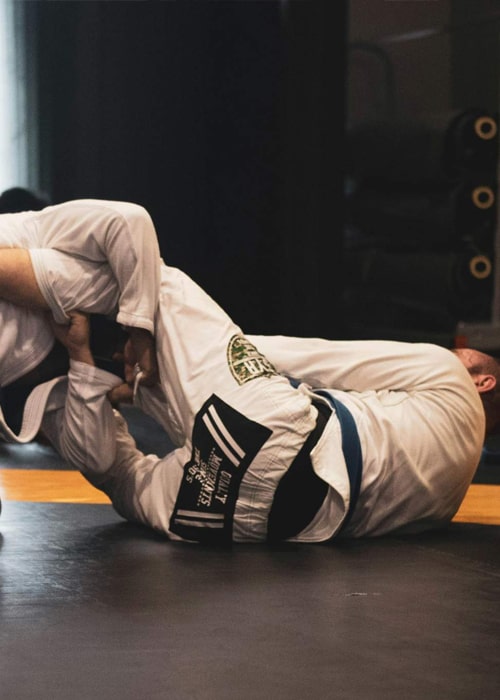
Today, Horizon Tatamis supports young people aged 12 to 25 at risk of experiencing psychosocial problems (particularly related to mental health, street gangs, or delinquency) through martial arts and combat sports.
Nicolas himself is passionate about martial arts—a journey that has been so formative for him on a personal level that he made it the subject of his thesis. “We always only talk about ourselves…” he says with humor.
Making Money to Help People
What makes Horizon Tatamis particularly unique is its social economy model: “We wear both hats: that of a community organization and that of a social economy enterprise.”
Because it is thanks to the revenue generated by a martial arts school open to the general public that the organization can pay its rent, its facilities, and maintain professional-quality premises.
This school isn’t just a sideline: it’s essential. Without the general public’s participation in classes, social interventions simply couldn’t take place.
Horizon Tatamis is also supported by the Borough of Saint-Laurent, the Ministry of Public Security, and other partners.
For the young people in intervention, everything is free: they have access to a minimum of three classes per week, supervised by coaches and counselors. The organization also works in several schools, youth centers, and other organizations.
More than just a hobby
Be careful not to confuse hobby with intervention, warns Nicolas.
“People often have the impression that through the practice of martial arts itself, young people will develop a kind of discipline, through transcendence… We think: oh yes, it’s good for channeling!” Except that learning that focuses solely on technical skills doesn’t guarantee the development of prosocial values. “We often see, with athletes who exhibit problematic behaviors off the field, that practicing sports in itself doesn’t necessarily guarantee prosocial behaviors.” It’s what we do with it that counts.
At Horizon Tatamis, each session is accompanied by a discussion workshop, the topic of which is initiated either by the instructors or by the young people themselves. Participants also complete a personal and athletic goals sheet, with regular follow-ups.
“The instructor’s role is to make the connection between the dojo and daily life.”
As a striking example, he cites consent. “What differentiates a fight in the dojo from a street brawl?” The setting. The rules. The right to withdraw at any time… These are concepts that can then be transposed into social and romantic relationships, at school, and at work.
The dojo as a mirror
Beyond personal interest, why choose martial arts to help young people?
“We could use any sport or artistic discipline for intervention,” Nicolas acknowledges. But martial arts are a rare opportunity to observe our fundamental reactions to violence: flight, avoidance, aggression, self-control. And from there, we work.
This context lends itself well to developing perseverance, communication, respect, and asserting one’s limits. We build relationships of trust, because the techniques are dangerous and we need each other to progress safely.
In other words, at Horizon Tatamis, we don’t just teach how to throw punches. We teach how to choose when not to throw punches and to name what’s wrong. We teach how to channel them, how to reflect, and how to move forward.
To learn more about their activities or contribute to their mission: Click here.